Mastering Realism in k6 Load Resting : Think Time and Dynamic Data
Load testing is more than just hitting an endpoint with requests. To simulate real users, you need 'think times.' Learn how to use k6 randomization methods to make your performance scripts more realistic and reliable.
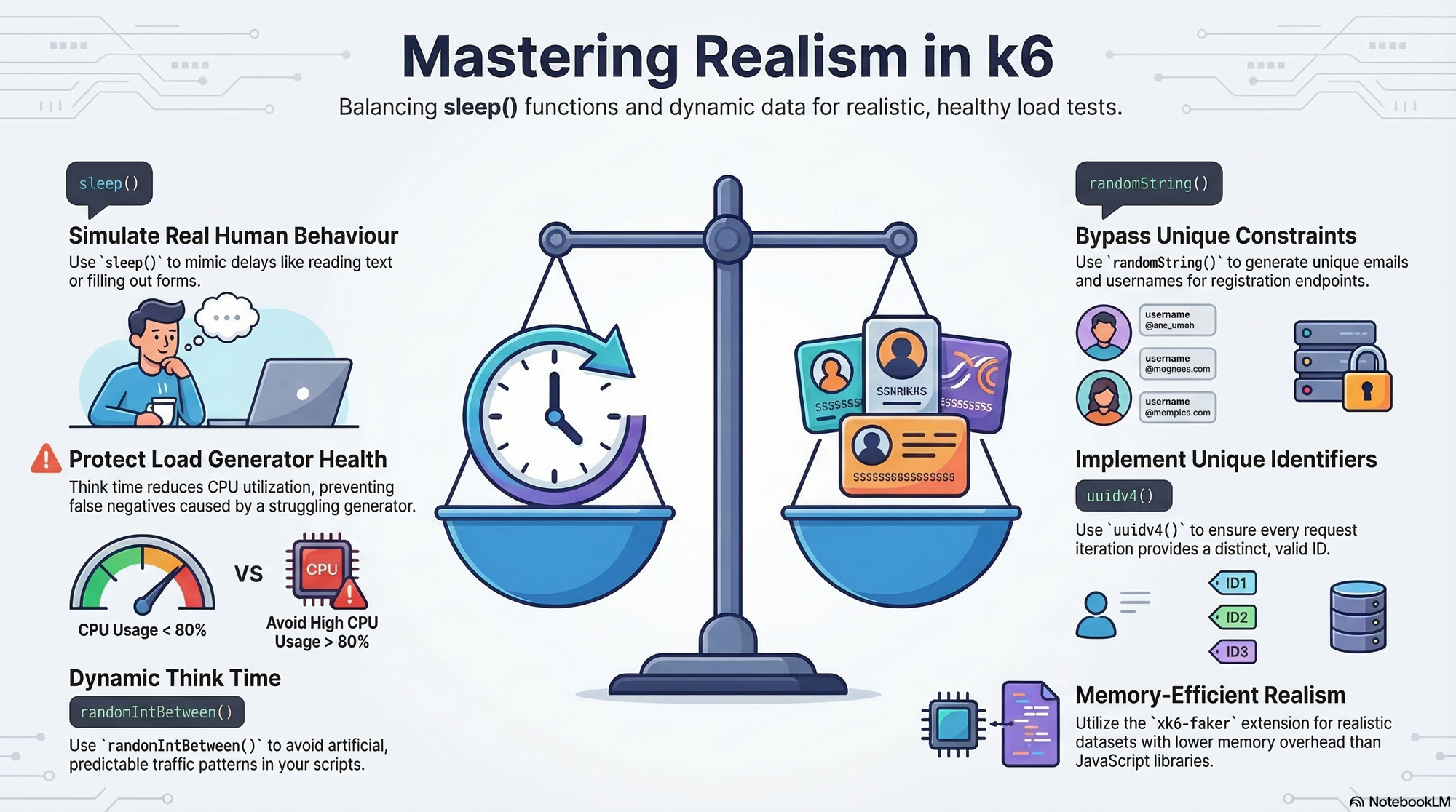
In the world of performance testing, "it works on my machine" is never enough. To truly understand how your application behaves under pressure, your scripts must mimic real users as closely as possible. Based on the latest k6 foundations and utility libraries, here is how you can achieve high - fidelity realism in your tests.
- The Power of the Pause : Think Time
Think time is the duration a script pauses during execution to simulate the delays real users have - such as reading a page or filling out a form.
**Why use it ? **
- Realism : It helps achieve test objectives by following natural user flows.
- Resource Managemenet : Removing think time can cause your load generator's CPU to spike (over %80), leading to inaccurate results or "false negative"
In k6, you implement this using the sleep() function. For instance, sleep(1) will pause the virtual user (VU) for exactly one second. While sleep time in included in the total iteration duration, it does not affect your https_req_duration metrics.
- Movin Beyond Hard - Coding : Dynamic Sleep
Hard-coding a 1-second delay creates an artificial pattern that doesn't exist in the real world. Testing best practice suggests using dynamic think time. You can use the jslib utility library to import randomIntBetween. This allows you to set a range, such as randomIntBetween(1, 5), so your VUs pause for a random number of seconds between 1 and 5, making the load much more unpredictable and realistic
import { sleep } from 'k6';
import { randomIntBetween, randomString, randomItem } from 'https://jslib.k6.io/k6-utils/1.2.0/index.js';

export const options = {
    vus: 5,
    duration: '30s',
};

export default function () {
    // 1. Rastgele Veri Üretimi (Unique Data)
    const randomName = `user_${randomString(5)}`;
    const randomEmail = `${randomName}@example.com`;
    const categories = ['electronics', 'books', 'fashion'];
    const selectedCategory = randomItem(categories);

    const payload = JSON.stringify({
        username: randomName,
        email: randomEmail,
        interest: selectedCategory
    });

    const params = {
        headers: { 'Content-Type': 'application/json' },
    };

    // 2. İstek Gönderimi
    http.post('https://httpbin.test.k6.io/post', payload, params);

    // 3. Dinamik Think Time (The Power of the Pause)
    // Yazında belirttiğin gibi 1 ile 5 saniye arası rastgele bekleme
    console.log(`VU ${__VU}: Thinking for a moment...`);
    sleep(randomIntBetween(1, 5));
}- Generating Unique Data for Realistic Scenarios
Real-word APIs often have unique constraints, such as registration endpoints that require unique emails or username. Usin the same data repeatedly can lead to database errors that wouldn't happen with unique users.
k6 provides built-in utility functions to handle this :
- randomString(lenght) : Perfect for generating unique usernames or parts of an email.
- uuidv4() : Generates a random UUID v4 string for unique identifiers.
- randomItem(array) : Picks a random element from a predefined list, useful for selecting different products or categories.
- Advanced Data Generation with xk6-faker
For even more complex datasets, the xk6-faker extension is a powerful ally. Implemented as a Go extension, it starts faster and uses less memory than standard JavaScript generators. It allows you to generate realistic-looking fake data (like names, addresses, and dates) with a pattern similar to the popular Faker.js library.
import { sleep } from 'k6';
import faker from 'k6/x/faker'; // using xk6-faker

export default function () {
    const payload = JSON.stringify({
        full_name: faker.person().name(),
        address: faker.address().city(),
        phone: faker.phone().number(),
        created_at: faker.date().past(1).toISOString()
    });

    http.post('https://httpbin.test.k6.io/post', payload);

    sleep(2);
}
Conclusion :
Realism in load testing isn't just about the number of users; it's about their behavior. By implementing dynamic think time and randomized test data, you ensure that your performance tests provide reliable, actionable insights for your production environment.