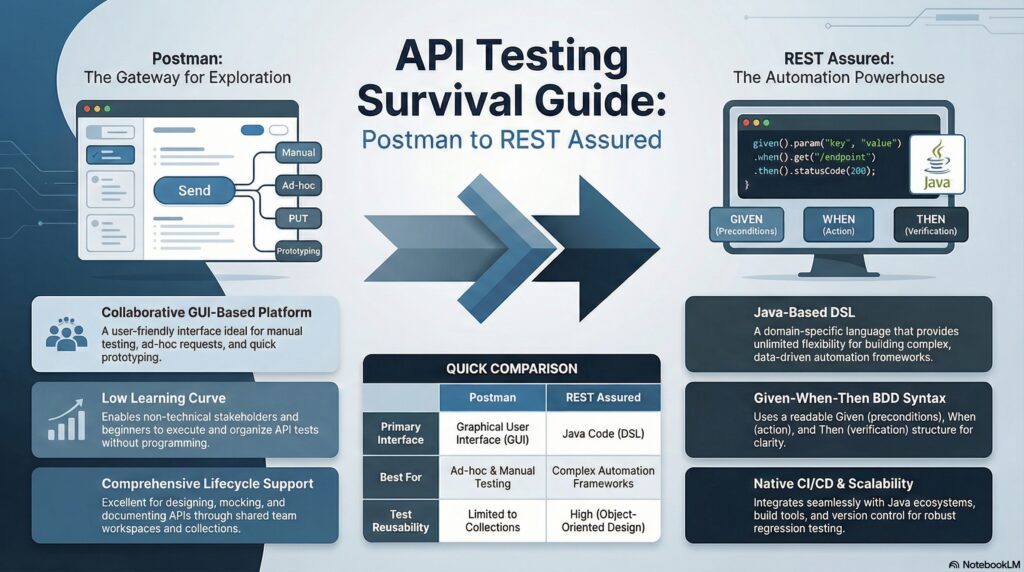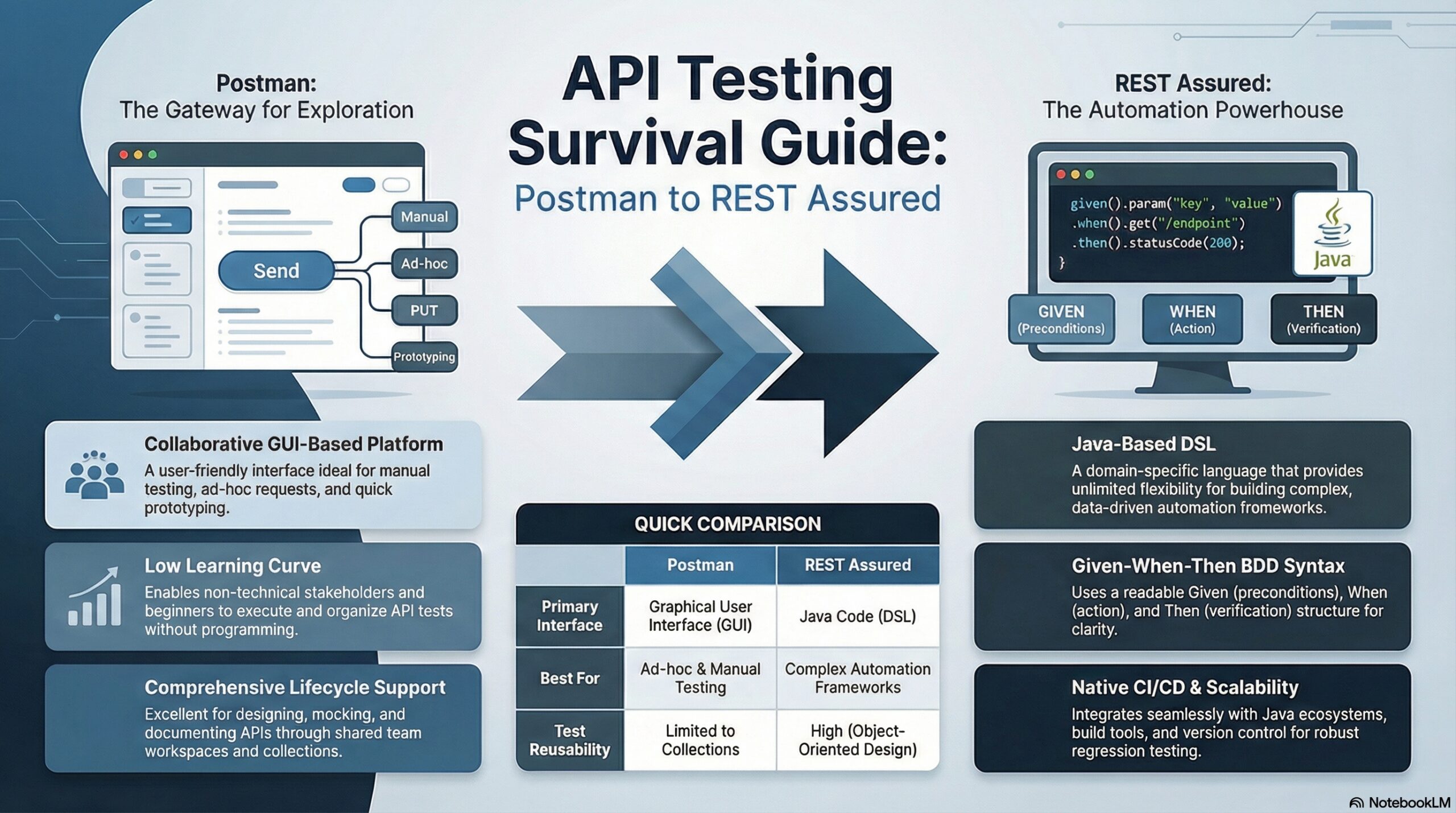
For many QA Engineers, Postman is the gateway into the world of APIs. Its user friendly interface makes it easy to send a request, look at a response, and feel like a detective solving a mystery. But as your project grows, you might find yourself hitting a wall. You have hundreds of collections, scripts that are hard to reuse, and a feeling that your testing process is lagging behind the speed of development.
This is the moment to consider REST Assured
Why Leave the Comfort of Postman ?
Postman is excellent for exploratory testing and quick prototyping. However, when it comes to long-term automation, REST Assured offers several critical advantages.
- Code Reusability : While Postman allows for JavaScript snippets, REST Assured is a Java-based library that lets you use object-oriented programming. This means you can build modular, reusable components and shared contexts (like authentication tokens), significantly reducing redundancy.
- Seamless CI/CD Integration : REST Assured fits natively into Java ecosystems. IT plugs effortlessly into build tools like Maven or Gradle and triggers automatically within CI/CD pipelines (like Jenkins or GitHub Actions) with every new build.
- Version Control : Since your tests are pure Java code, then live in your source control (like Git) alongside the application code. This makes collaboration, tracking changes, and code reviews much more natural for a development team.
The Secret Sauce : Readable Tests with BDD
One of the most powerful features of REST Assured is its Domain-Specific Language (DSL), which follows the Behavior-Driven Development (BDD) structure : Given – When – Then
This structure transforms cryptic code into something that reads like a human sentence, making your tests accessible even to non-technical stakeholders.
- Given : Describes the preconditions and initial state (headers, parameters, or the request body)
- When : Describes the action taken (the GET, POST, or DELETE request)
- Then : Describes the expected outcome (status codes or data validation)
Simple Example : From Clicking to Coding
Let’s look at how intuitive this transition is with two basic examples.
- The GET Request
In Postman, you’d paste a URL and click “Send” in REST Assured, it looks like this
given() .baseUri(“https://api.example.com”) when() .get(“/users/1”) then() .statusCode(200) .body(“name”, equalTo(“John Doe”));
The test is concise and tells you exactly what it’s doing : Given the base URI, when we get user 1, then we expect a 200 status and the name “John Doe”
2. The POST Request
Creating data is just as straightforward. You define your payload and send it :
given()
.contentType(“application/json”)
.body(“{\”name\”: \”Jane\”, \”role\”: \”Admin\”}”)
when()
.post(“/users”)
then()
.statusCode(201);
Here, you are verifying that your API correctly processes the “Create” command and returns the standard 201 Created status.
Conclusion : Embracing the “Readable Test”
The goal of shifting to REST Assured isn’t just to “write code” it’s to create readable tests. By using the BDD syntax, your automation suite becomes a living piece of documentation that explains exactly how your API should behave.
While Postman remains a fantastic tool for exploration, REST Assured is the powerhouse you need to build a scalable, maintainable, and processional automation framework