For nearly two decades, Selenium has been the undisputed titan of browser automation. However, as we navigate the complexities of web development in 2025 and 2026, the industry is witnessing a massive shift. Modern, component-driven architectures like React, Vue, and Angular have introduced dynamic DOM mutations that traditional testing tools often struggle to handle without significant overhead. This is where Playwright enters the frame – not merely as another tool, but as a paradigm shift in test automation.
The Power of Modern Architecture
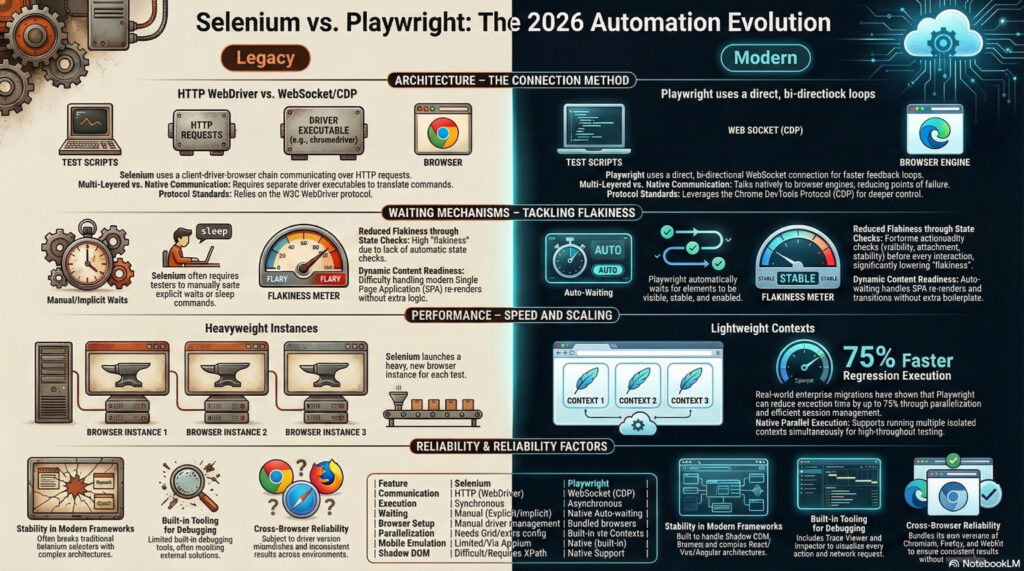
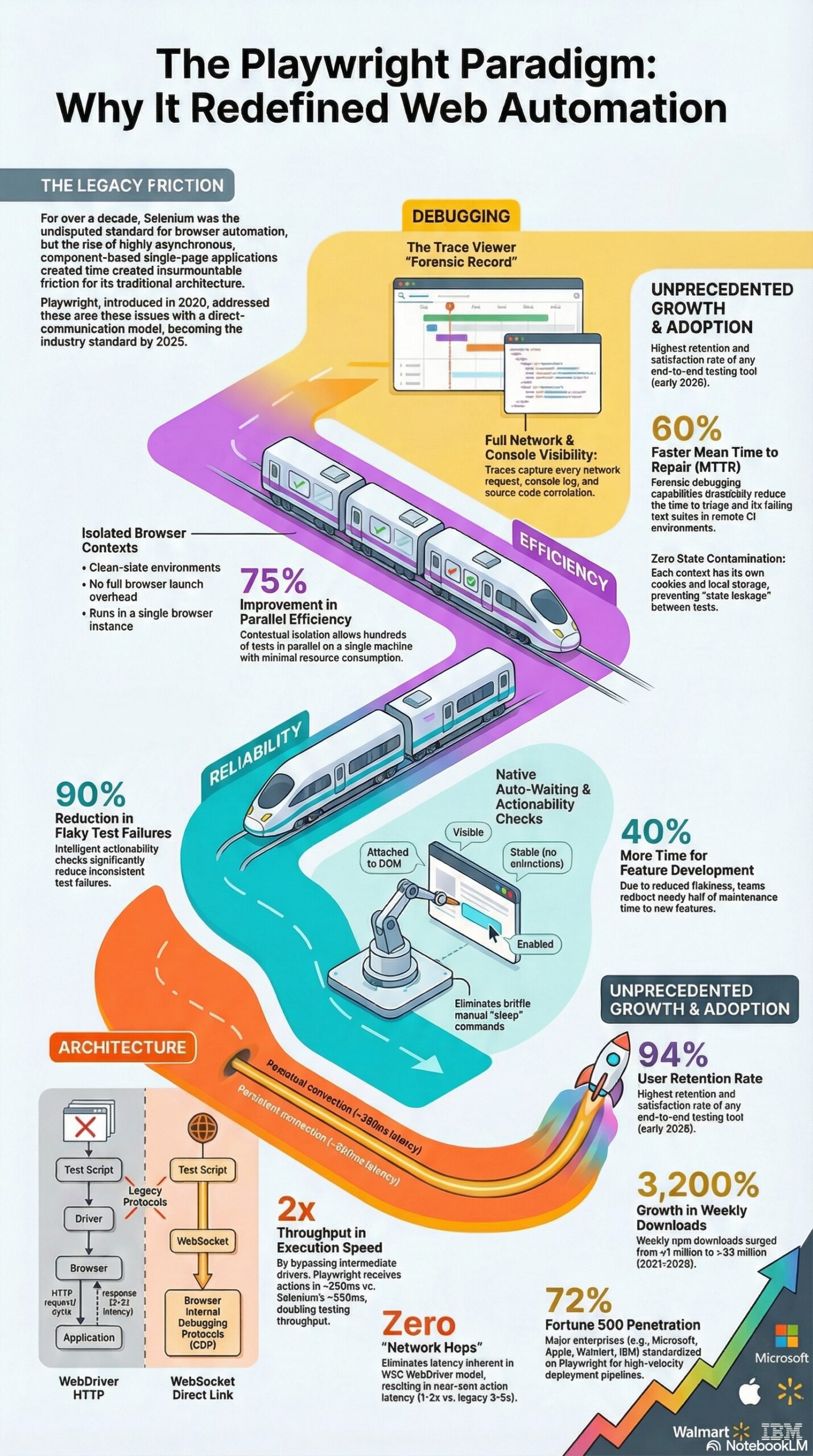
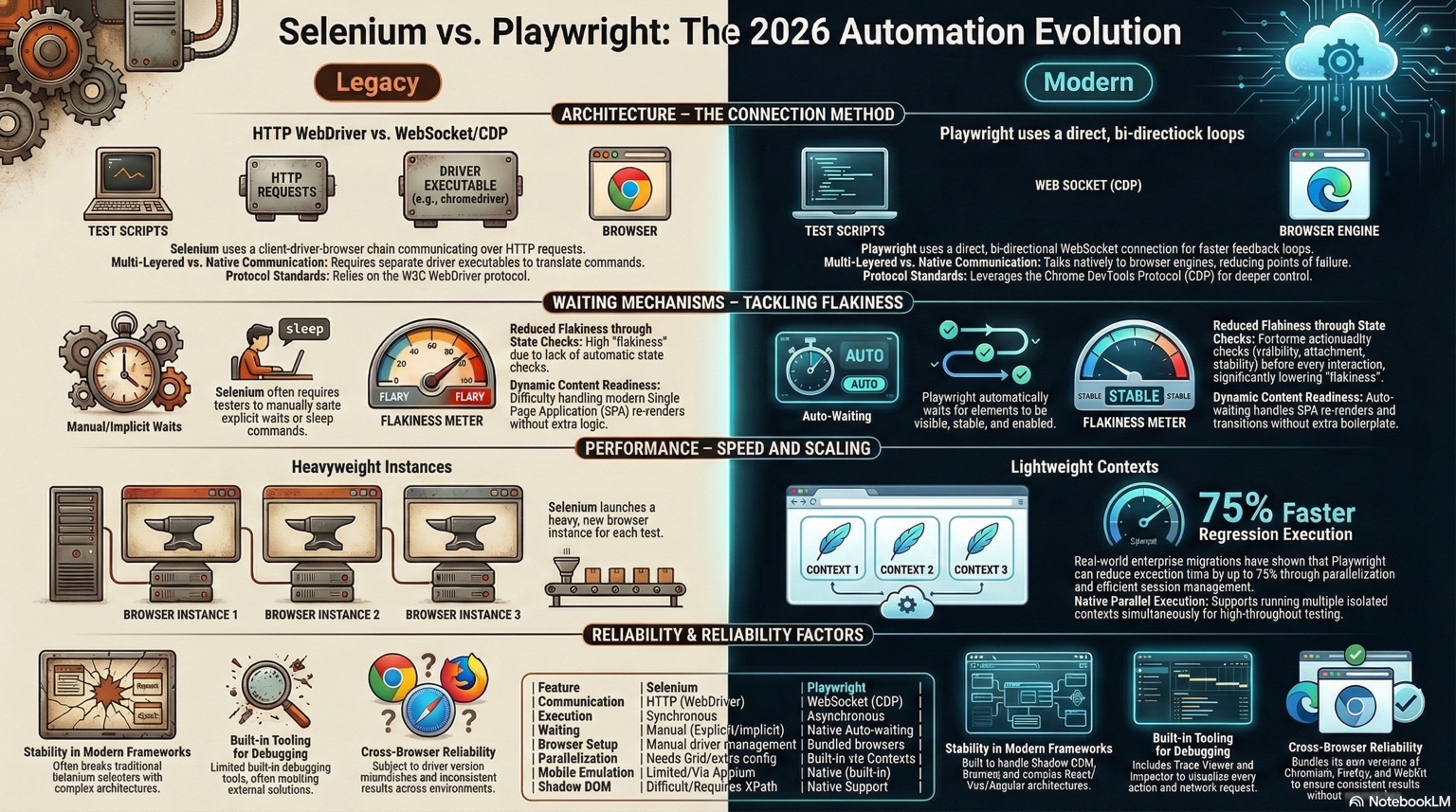
The fundamental difference between these two frameworks lies in their underlying Modern Architecture. Selenium relies on the W3C WebDriver protocol, which uses a client-server model where every interaction – a click, a navigation, or a keystroke – is sent as an HTTP request to a driver executable, which then communicates with the browser. This multi – layered approach introduces inherent latency.
In contrast, Playwright utilizes a direct, bidirectional communication channel via WebSockets, tapping into native automation protocols like the Chrome DevTools Protocol (CDP). This allows Playwright to skip the “middleman”. The result is a lightning – fast feedback loop and the ability to manage Browser Contexts – lightweight, isolated sessions that act as independent browser profiles within a single process. This architecture enables running hundreds of tests in parallel with minimal resource consumption compared to Selenium’s process – heavy model.
Solving the Flakiness Crisis : Auto – waiting
Perhaps the greatest pain point for Selenium users is “flakiness” – tests that fail intermittently due to timing issues. Selenium tests often require manual “Explicit Waits” or brittle sleep commands to ensure an element is ready for interaction.
Playwright addresses this head-on with Auto-waiting. Before performing any action, Playwright’s internal engine performs a battery of “actionability” checks. It automatically ensures the element is :
- Attached to the DOM
- Visible and stable (not animating)
- Enabled and not obscured by other elements
This built-in patience results in Reduced Flakiness. By aligning test execution with the browser’s internal rendering lifecycle, Playwright eliminates the need for arbitrary timeouts, making your CI/CD pipelines significantly more reliable.
Advanced Capabilities for Modern Apps
Migration to Playwright isn’t just about speed: it’s about capability. Modern web features that were notoriously difficult to test in Selenium are handled natively in Playwright :
- Shadow DOM & iFrames : Playwright can “pierce” the Shadow DOM without complex XPath workarounds, which is essential for modern web components.
- Network Interception : Playwright allows you to mock APIs, stub network responses, and even simulate slow network conditions directly within the test script – a feature that often required external proxies in the Selenium ecosystem.
- Mobile Emulation : With a single line of code, developers can emulate device viewports, user agents, and touch capabilities.
Weighing the Disadvantages
Despite its clear advantages, a migration is a strategic investment that comes with challenges :
- Learning Curve : Teams must adapt from Selenium’s synchronous model to Playwright’s Asynchronous API (async/await)
- No Automated Converter : There is no “magic button” to convert Selenium scripts to Playwright. While tools like Codegen can accelerate the process by recording user actions, the existing codebase must be largely rewritten.
- Ecosystem Maturity : While growing rapidly, Playwright’s third-party integration library and community knowledge base are still smaller than the two decades of documentation available for Selenium
The Migration Roadmap : A Phased Approach
A successful migration should be an evolution, not a revolution. Experts recommend a hybrid setup where Selenium and Playwright tests run side-by-side in the same CI pipeline.
- Setup the Environment : Integrate the Playwright library alongside your existing suite.
- Pilot with New Tests : Write all new features and tests in Playwright to familiarize the team with its API
- Prioritize Critical Paths : Gradually migrate the most critical or “flakiest” Selenium tests to Playwright to see immediate stability gains.
- Validate Functional Parity : Run both versions in parallel until the Playwright versions prove stable.
Conclusion
Switching to Playwright is a forward-thinking move for any organization dealing with high-velocity software delivery. By leveraging its Modern Architecture and Auto-waiting mechanisms, teams can achieve Reduced Flakiness and faster execution times. While the initial rewriting effort is a hurdle, the long-term ROI-measured in developer productivity and test reliability-makes Playwright the definitive choice for the next generation of web testing.